Pregnancy and breastfeeding are among the most transformative experiences a woman can go through — and the breasts bear the clearest signs of that journey. They grow, fill with milk, nourish a baby for months and then, once breastfeeding ends, often never quite return to how they were before.
If you have finished breastfeeding and noticed that your breasts have lost volume, firmness or their previous position, you are far from alone. It is one of the most common reasons women visit our Málaga clinic and our Marbella clinic. In this article, Dr. Brianda Hurtado de Mendoza explains exactly what happens to the breast after pregnancy, when the timing is right to consider surgery, and what you can realistically expect from the process and the result.
| 💡 Important note:
This post focuses on the post-pregnancy and post-breastfeeding context as a specific augmentation decision. If your main concern is breast drooping without significant volume loss, also read our guide on mastopexy (breast lift). If you are looking for a comprehensive body restoration after motherhood, the Mommy Makeover may be the most complete option. |
1. What Happens to the Breasts During and After Breastfeeding
To understand why the breasts change so much, it helps to know what is happening from the inside. During pregnancy, rising oestrogen and progesterone levels stimulate the growth of glandular tissue: the breast prepares to produce milk and can increase considerably in size.
During breastfeeding, this tissue remains active. The skin and Cooper’s ligaments — the fibrous structures that support the breast — stretch progressively to accommodate the increased volume. When breastfeeding ends and milk production stops, the glandular tissue involutes (shrinks), but the skin and ligaments no longer regain their original tension.
The most common changes patients describe:
- Volume loss: the breasts feel smaller than before pregnancy, or have an ’empty’ appearance in the upper pole.
- Drooping or ptosis: the breast descends and loses the position and firmness it once had.
- Shape changes: breasts may appear flatter, more elongated, or noticeably asymmetric.
- Changes to the areola: it may appear larger or positioned lower than before.
These changes are completely normal and do not indicate any health problem. But they are one of the main reasons women seek a consultation once their breastfeeding journey is complete.
2. When Is the Right Time to Have Surgery?
This is the most important question — and also the most frequently asked. The answer depends on several factors, but one condition is non-negotiable:
| ⭐ The fundamental rule: wait at least 6 months after you have completely stopped breastfeeding before considering any breast procedure.
This period is necessary to allow the breast tissue to fully stabilise after glandular involution. Operating too soon can compromise the result, as the breast is still changing. |
Other important criteria before surgery:
- Stable weight: ideally, you should be at or near your pre-pregnancy weight and have maintained it for at least 2–3 months. Significant weight changes after surgery will affect the result.
- Family planning: if you are planning another pregnancy in the near future, it is advisable to wait. A subsequent pregnancy can partially reverse the surgical result.
- Good general health: no active infections, no contraindicated medications, and pre-operative test results within normal range.
- Realistic expectations: surgery can deliver a significant improvement, but it cannot guarantee perfection. The initial consultation is precisely where expectations are aligned and what is achievable for your specific case is explained.
3. Augmentation, Lift or Both: How to Know What You Need
Not every woman in the same situation needs the same procedure. Depending on how your breasts have changed after breastfeeding, the solution may be different:
| Your situation | What you have lost | Most appropriate procedure |
| Smaller breasts than before, but well-positioned | Volume (not firmness or position) | Breast augmentation with implants |
| Drooping breasts with volume preserved | Firmness and position (not volume) | Mastopexy (breast lift without implant) |
| Drooping AND smaller than before | Volume + firmness + position | Mastopexy + breast augmentation (combined) |
| Changes also in abdomen or intimate area | Multiple: abdomen, breast, contour | Mommy Makeover (comprehensive approach) |
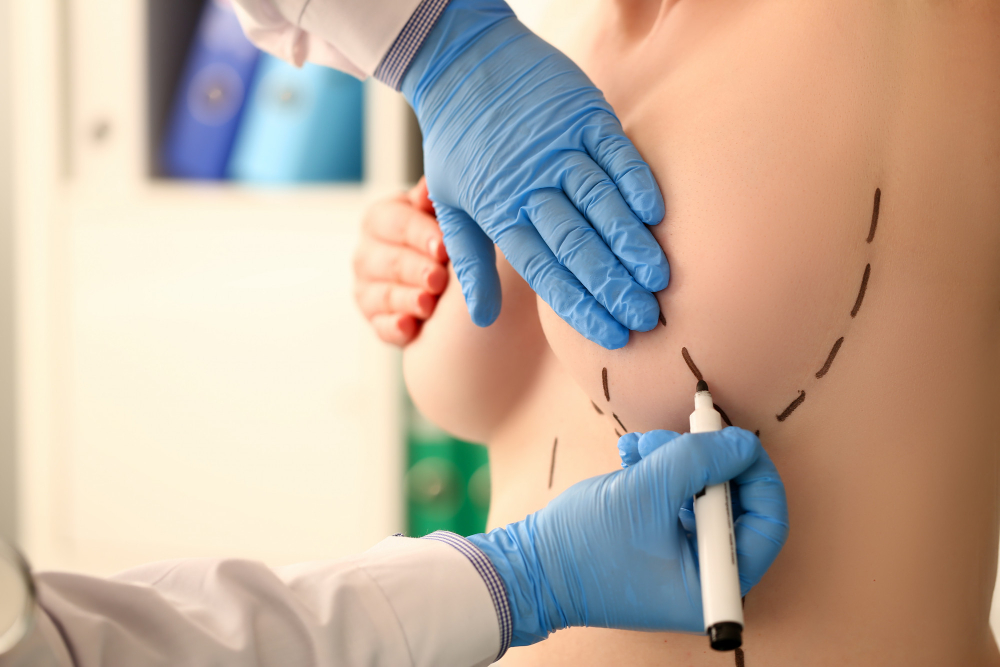
Dr. Brianda will carry out a personalised assessment of your degree of ptosis (drooping), skin quality, volume lost and your goals to recommend the most appropriate combination for you. There is no universal answer — there is the right answer for your case.
4. Post-Breastfeeding Breast Augmentation: What Is Different
A breast augmentation after breastfeeding has some particularities that set it apart from augmentation in women who have not been pregnant:
The breast tissue has changed:
The glandular tissue has involuted and there may be more fibrous, less dense tissue than before. This influences the choice of implant size and profile to achieve a natural and proportional result.
The skin may be more distended:
Depending on the extent of change after breastfeeding, the skin may have less elasticity. In cases of mild ptosis, the implant alone can improve breast position. In cases of moderate to severe ptosis, combining the augmentation with a mastopexy will be necessary to achieve a good result.
The implant size is not always what you expect:
Many patients believe they need a large implant to restore the volume they have lost. In many cases, however, a moderate-size implant with the right profile achieves a far more natural and proportional result. Dr. Brianda always tailors the recommendation to each patient’s actual body, not a standard size.
5. Can You Breastfeed After Breast Augmentation? Myths and Facts
This is one of the most frequent questions, especially from patients who have not yet completed their family planning. The short answer is: in the vast majority of cases, yes.
- Breast implants do not affect the milk ducts or glandular tissue when placed in the submuscular or subfascial plane.
- The most common incision approach (inframammary fold) avoids the periareolar area, so nipple innervation is preserved in the majority of cases.
- Breastfeeding is possible after breast augmentation, although it cannot be guaranteed in 100% of cases.
6. The Most Common Combination: Mastopexy With Augmentation
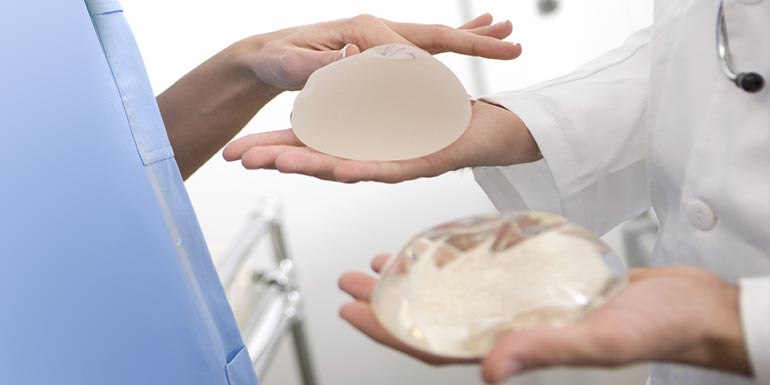
In many patients who have breastfed, volume loss and breast drooping go hand in hand. In these cases, the most complete solution is to combine breast augmentation with implants and a mastopexy (breast lift) in a single surgical procedure.
What each procedure contributes to the combination:
- The augmentation restores lost volume, particularly in the upper pole that tends to appear deflated after breastfeeding.
- The mastopexy repositions the breast tissue, removes excess skin and raises the nipple-areola complex to a more youthful and harmonious position.
- The combined result is a firm, voluminous, well-positioned breast — something neither procedure could achieve alone in cases of moderate to severe ptosis.
You can read more about this combination in our full guide to breast lift and breast augmentation.
7. What If Other Areas Have Changed Too? The Mommy Makeover
For many women, the changes that follow motherhood are not limited to the breasts. The abdomen may have been left with diastasis recti or loose skin, changes may have occurred in the intimate area, and localised fat deposits may not respond to exercise.
In those cases, the Mommy Makeover is a comprehensive surgical option that allows several areas to be addressed in a single procedure, reducing the number of operations and total recovery time. Every Mommy Makeover is tailored: there is no standard package, but a personalised combination based on each patient’s individual needs.
8. Recovery: What to Expect If You Combine Augmentation and Lift
If you are having breast augmentation only, the recovery is very similar to what we describe in our detailed post on breast augmentation recovery week by week. If combined with a mastopexy, timelines are similar although there may be slightly more discomfort and additional incision sites.
General recovery timeline:
- First 48 hours: rest, bandage or postoperative bra, prescribed medication.
- Week 1: drain removal and first clinic check-up. Relative rest at home.
- Days 7–10: suture removal. Most patients feel significantly better by this point.
- Weeks 2–3: gradual return to social and work life (office-based work).
- Months 1–3: implants settle into their final position and all swelling resolves.
- Month 6: result is essentially definitive. Scars continue to mature until 12–18 months.
| 💡 An important note for mothers:
For the first 4–6 weeks after surgery, you will not be able to lift your children or any heavy objects. It is essential to arrange family or partner support for this period before your surgery date. A well-planned recovery is part of the result. |
Conclusion: The Right Time Exists — and It Is Personal
There is no universal age or timeline for considering breast surgery after breastfeeding. What does exist are conditions that must be met for the result to be safe, predictable and lasting: stabilised tissue, stable weight, completed family planning and realistic expectations.
If you think the time may be right, the first step is a no-obligation consultation with Dr. Brianda. You will be able to resolve all your questions, explore the options that suit your case, and make a decision with full information. We look forward to seeing you at our Málaga clinic or our Marbella clinic.
Is it your time? Book a consultation with Dr. Brianda
Málaga & Marbella · +34 638 327 138 · info@drabrianda.es
→ Full information: Breast Augmentation in Málaga and Marbella