
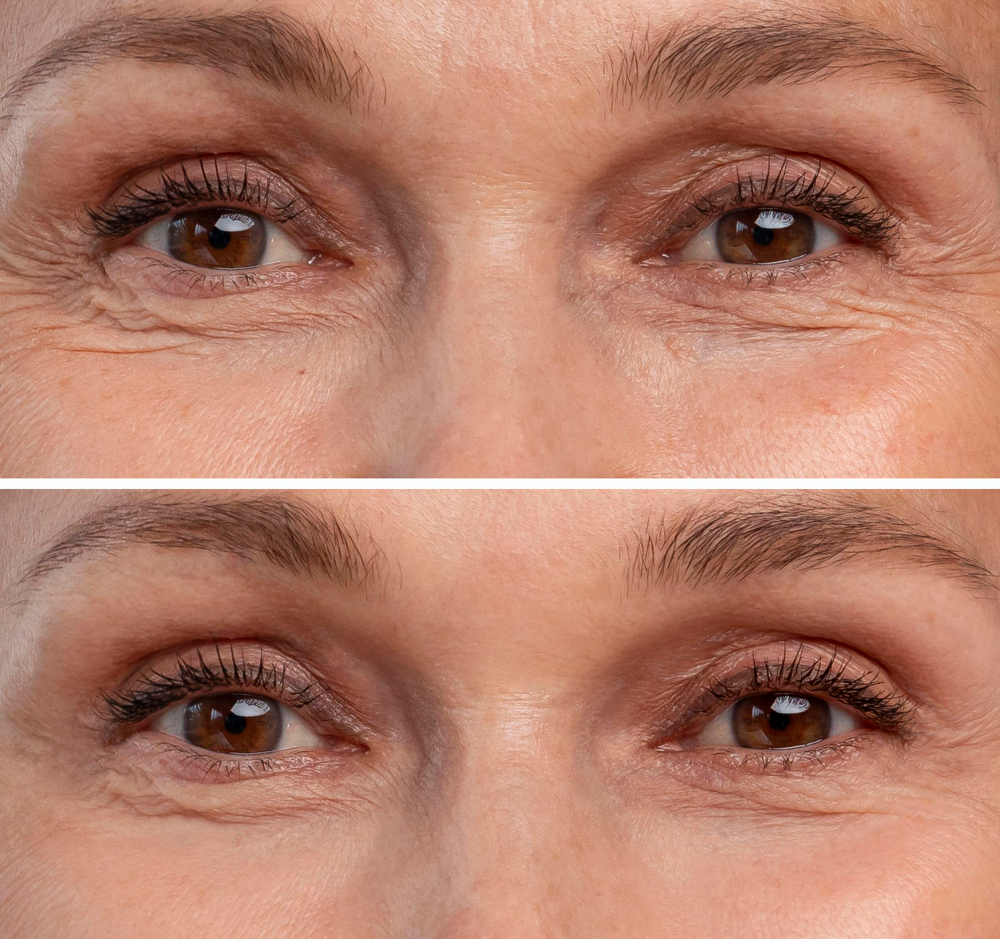
Crow’s feet are the small lines that form at the outer corners of the eyes when we smile, squint, or make other facial expressions. Over time they stop fading once the face relaxes and become a visible wrinkle even at rest. They aren’t a sign of poor skincare — this area has very thin skin, almost no fat or sebaceous glands, and is subject to constant muscle movement from childhood onward.
The good news is that, unlike other wrinkles, crow’s feet respond very well to aesthetic medicine. In this post we explain why they form, what treatments are available to reduce or eliminate them, and what you can do day to day to delay their appearance.
Why do crow’s feet form?
The eye area ages before the rest of the face for several reasons that usually overlap:
- Very thin skin: it has far less thickness than the rest of the face, making it more vulnerable to collagen and elastin loss.
- Repeated muscle movement: the orbicularis oculi muscle contracts every time we smile, laugh, or squint against the sun, gradually marking expression lines.
- Sun exposure: this is one of the areas people protect least with sunscreen, and UV damage speeds up the formation of fine lines.
- Loss of volume and firmness with age: from around age 30-35, collagen production declines and lines that used to appear only when smiling start to stay visible at rest.
Aesthetic medicine treatments for crow’s feet
Botulinum toxin
Botulinum toxin is the gold-standard treatment for crow’s feet caused by muscle contraction. Small doses are injected into the outer orbicularis oculi muscle, reducing its activity and smoothing expression lines without affecting the naturalness of your smile or expression.
Results start to show within 24-72 hours of the injection, reach their maximum effect at 1-2 weeks, and typically last between 3 and 4 months. It’s an outpatient treatment with no anaesthesia and no downtime, so you can go straight back to your routine.
Important: botulinum toxin works on dynamic wrinkles (the ones caused by muscle movement). It does not improve fine lines caused by sun damage or sagging from loss of skin tension — for those cases it’s combined with other treatments or, when there’s noticeable excess skin, with surgery.
You can find more detail on this treatment, its indications and contraindications, on our botulinum toxin wrinkle treatment page.
Hyaluronic acid
When crow’s feet come with volume loss or noticeable under-eye hollowing, hyaluronic acid helps rehydrate the skin and subtly restore volume in the area, improving the quality and brightness of the eye contour. It’s often combined with botulinum toxin for a more complete result.
Radiofrequency and Morpheus8
For patients who want to improve skin firmness and texture in addition to smoothing expression lines, treatments such as radiofrequency or Morpheus8 stimulate collagen production progressively. They don’t replace botulinum toxin, but they’re a great complement when sagging or reduced skin quality is the main concern rather than dynamic wrinkles.
Eyelid surgery, for cases with excess skin
When there’s excess eyelid skin or noticeable bags that aesthetic medicine can’t resolve, surgery is the solution. Eyelid reduction (blepharoplasty) removes that excess skin and fat, achieving a more rested, rejuvenated look. You can read more about this procedure in our post «Blepharoplasty: What It Is, Benefits and How to Rejuvenate Your Eyes».
Tips to prevent and delay crow’s feet
Aesthetic medicine gives its best results when paired with a good daily skincare routine:
- Wear sunscreen every day: apply an SPF formulated for the eye area, even in winter or on cloudy days.
- Wear sunglasses: besides protecting against UV radiation, they stop you from squinting repeatedly.
- Keep the area hydrated: well-hydrated skin shows expression lines less. Look for eye-contour creams with hyaluronic acid or peptides.
- Add topical antioxidants: vitamin C and retinol (in concentrations suitable for this sensitive area) help stimulate collagen.
- Avoid rubbing your eyes: constant rubbing weakens the skin and speeds up sagging.
- Look after your sleep and avoid smoking: both directly affect skin quality and elasticity.
Tip: no skincare product reverses a wrinkle that’s already set in from repeated muscle contraction. Topical care is an excellent complement for maintaining results and prevention, but once the line is visible at rest, a medical aesthetic treatment is what actually smooths it out.
Which treatment is right for me?
There’s no one-size-fits-all protocol: it depends on whether the wrinkle is purely dynamic, whether there’s volume loss, sagging or excess skin, and on each patient’s goals. At Doctora Brianda we assess every case individually, at our clinics in Malaga and Marbella, to design a personalised treatment plan — whether that’s botulinum toxin, hyaluronic acid, skin-quality treatments or, if needed, surgery.
Frequently asked questions
Does botulinum toxin treatment for crow’s feet hurt?
It’s applied with a very fine needle and doesn’t require anaesthesia. You may feel a brief pinch-like sensation.
How long do results last?
Between 3 and 4 months, depending on the patient and the dose used. With repeated treatments over time, many patients find the effect lasts longer.
Is it safe to combine botulinum toxin and hyaluronic acid in the same session?
Yes, it’s a common and safe combination when performed by a qualified medical professional, since they work in complementary ways: one reduces muscle movement while the other adds volume and hydration.
At what age should crow’s feet be treated?
There’s no fixed age. Some people start treating them preventively from around 25-30, when the line begins to show with smiling, while others come in once the wrinkle is already visible at rest.
Want to have your case assessed?
At Doctora Brianda we look at your skin and your goals to recommend the most suitable treatment for your crow’s feet, at our clinics in Malaga and Marbella.
- : +34 638 327 138
- Email: info@drabrianda.es
- Malaga clinic: Andalucía 21, Entreplanta 2, Edif. Myramar, 29002 Málaga
- Marbella clinic: Hospital Ochoa, C/ Doña Maestra Carola 8, 29602 Marbella