
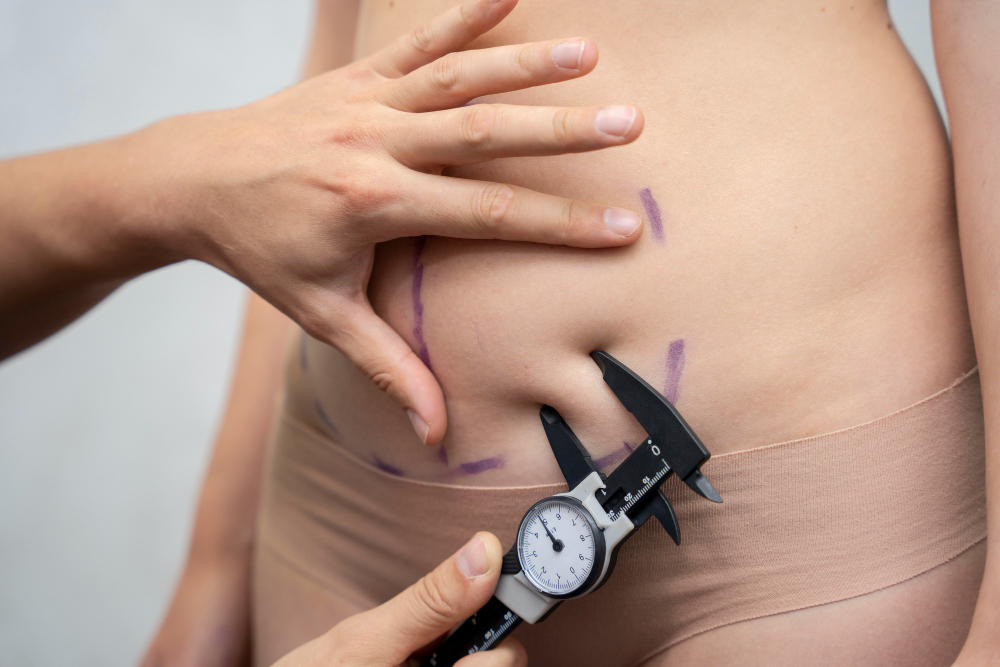
When the abdomen refuses to respond to diet and exercise the way you hoped, two surgical procedures dominate the conversation: a tummy tuck (abdominoplasty) and liposuction. Both improve abdominal contour, both are performed under anaesthesia, and both offer lasting results. But they are not interchangeable — and confusing one with the other leads to frustrated expectations and outcomes that fall short of what the patient was actually looking for.
In this article, Dr. Brianda Hurtado de Mendoza explains clearly and directly what each procedure does, who is the ideal candidate for each, what happens when they are combined, and — most importantly — how to know which one is right for you.
| 💡 This post is a decision guide, not a technical description.
For detailed information about each procedure, visit the abdominoplasty and liposuction service pages at the clinic. Here, the focus is on helping you choose. |
1. The First Question to Ask Yourself: What Exactly Do You Want to Correct?
Before comparing procedures, there is a fundamental distinction that defines which one is right for you:
| 🔑 The decision key:
Liposuction removes localised FAT. The skin must have good elasticity to retract afterwards. A tummy tuck removes EXCESS SKIN and repairs SEPARATED MUSCLES, as well as extracting fat.
If your concern is fat only → liposuction may be enough. If your concern is loose skin or separated muscles → you need a tummy tuck. |
This simple principle resolves the majority of doubts — but there are many nuances worth exploring in detail.
2. What a Tummy Tuck Is and What It Does
A tummy tuck (abdominoplasty) is a surgery that addresses the abdomen on three levels simultaneously:
- Removes excess abdominal skin (especially from the lower abdomen).
- Extracts localised fat from the treated area.
- Repairs diastasis recti (separation of the abdominal muscles) when present, tightening the muscular wall.
The result is a flat, firm abdomen with a redefined silhouette that no non-surgical treatment can achieve when there is genuine skin excess. The trade-off is a horizontal scar low on the abdomen (at pubic hairline level) and, in most cases, a periumbilical scar.
Types of tummy tuck:
- Mini-abdominoplasty: corrects only the lower abdomen without repositioning the navel. Shorter scar. Suitable for mild cases.
- Full abdominoplasty: removes all skin between the pubis and navel, repositions the navel. The most common procedure.
- Extended abdominoplasty: also addresses the flanks and lower back. For cases of significant weight loss.
A tummy tuck can be combined with liposuction in the same surgical session for a more complete result, particularly in the flanks and waist.
3. What Liposuction Is and What It Does
Liposuction is a surgical technique that removes localised fat deposits using a cannula inserted through small incisions. It does not remove skin or repair muscles.
- Targets fat deposits that are resistant to exercise and diet.
- Can treat multiple areas in the same procedure: abdomen, flanks, waist, thighs, back, chin.
- Fat cells removed do not regenerate: the contour change is permanent if weight is maintained.
- The safety limit is approximately 3–4 litres of extracted fat in a single session.
| ⚠️ A fundamental limitation of liposuction:
If the skin has poor elasticity, removing the underlying fat can leave it looser. In those cases, liposuction alone will not deliver a good result — it may need to be combined with a tummy tuck or performed alongside complementary technology (Bodytite, Morpheus8). |
The fat extracted during liposuction can be repurposed to enhance other areas of the body through fat transfer (lipotransfer): buttocks, breasts, face or hands. Learn more about the results of fat transfer at Dr. Brianda’s clinic.
4. Direct Comparison: Tummy Tuck vs Liposuction
The table below summarises the key differences between both procedures:
| Criterion | Tummy Tuck | Liposuction |
| What does it correct? | Excess skin + fat + separated muscles | Localised fat only |
| Removes excess skin? | Yes — primary indication | No |
| Repairs diastasis recti? | Yes | No |
| Removes fat? | Yes (complementary to skin removal) | Yes — primary objective |
| Scarring? | Yes: low horizontal scar + periumbilical | Minimal (3–5 mm incisions) |
| Anaesthesia | General (always) | General or sedation |
| Surgery duration | 2–4 hours | 1–3 hours (depending on areas) |
| Hospital stay | Usually 1 night | Day case or 1 night |
| Recovery | 4–6 weeks | 1–3 weeks |
| Compression garment | Yes — 4–6 weeks | Yes — 2–3 weeks |
| Removes stretch marks? | Yes, those on the lower abdomen | No |
| Definitive result | At 6 months | At 3–6 months |
| Longevity of result | Permanent (with stable weight) | Permanent (with stable weight) |
| Can be combined? | Yes — in the same surgical session | Yes — frequently alongside a tummy tuck |
5. Candidate Guide: Who Is Best Suited for Each Procedure
This is the most common question in consultation. The table below covers the most frequent patient profiles:
| Patient profile | Tummy tuck? | Liposuction? | Notes |
| Clear excess skin after pregnancy or weight loss | ✅ | ❌ | Only a tummy tuck can remove loose skin |
| Localised fat with elastic skin and good muscle tone | ❌ | ✅ | Liposuction is sufficient; the skin will retract naturally |
| Diastasis recti (separated abdominal muscles) | ✅ | ❌ | Only a tummy tuck repairs the muscular wall |
| Fat + loose skin + separated muscles (mixed case typical after pregnancy) | ✅ | ✅ | Combined in one session: the most complete result |
| Fat accumulation on flanks or waist, no excess skin | ❌ | ✅ | Liposuction works well on these lateral areas |
| Stretch marks on the lower abdomen | ✅ | ❌ | Tummy tuck removes the skin — and the stretch marks with it |
| Significant weight loss (>20 kg) | ✅ | ⚠️ Con cautela | Skin removal is required; lipo as a complement |
| Previous abdominal surgery (C-section, hernia) | ✅ | ⚠️ Con cautela | Tummy tuck can improve existing scars |
| Active obesity or highly variable weight | ❌ | ❌ | Better to wait for stable weight before any procedure |
6. When Does It Make Sense to Combine Both?
In many cases — especially after pregnancy or significant weight loss — the most complete solution is to combine both techniques in a single procedure. This is common practice and safe when performed by a surgeon experienced in body contouring.
The combination allows:
- Removing excess skin and repairing the muscles with the tummy tuck.
- Refining the waist and flanks with simultaneous lateral liposuction.
- Achieving the best possible result in a single recovery.
This combination is also the core of the Mommy Makeover — the comprehensive approach that restores body contour after motherhood, adding breast surgery and, in some cases, labiaplasty.
7. What Neither Procedure Can Do
Equally important as knowing what each procedure does is understanding its limits. Being clear about this before a consultation prevents expectations that are out of line with what is achievable:
Neither is a treatment for obesity:
Both procedures target localised fat deposits or excess skin — not overall body weight. The ideal candidate is someone at or near their stable, healthy weight.
Liposuction does not tighten skin:
When there is skin laxity, liposuction can worsen it. Only surgical skin removal (a tummy tuck) can correct it.
A tummy tuck does not remove fat from other areas:
A tummy tuck addresses the abdomen. For other areas — thighs, arms, distal flanks — liposuction is the necessary complement.
Results are maintained with a healthy lifestyle:
Significant weight gain after surgery can reverse the result. Both procedures are long-lasting if weight remains stable.
8. How the Decision Is Made in Consultation
Dr. Brianda carries out a full clinical assessment in consultation to recommend the most appropriate procedure. The factors evaluated include:
- Amount and distribution of abdominal fat.
- Degree of ptosis or excess skin.
- Presence and severity of diastasis recti (assessed by physical examination or ultrasound).
- Skin quality and elasticity.
- Previous abdominal surgery (C-sections, hernias, appendectomies).
- Patient goals and expectations.
- General health status and pre-operative test results.
There is no universally correct result. There is the right result for your body, your history and your goals.
Conclusion: The Difference That Changes the Outcome
Choosing between a tummy tuck and liposuction is not a matter of preference — it is a matter of clinical diagnosis. Fat is removed with liposuction. Excess skin and separated muscles can only be corrected with a tummy tuck. And when the problem is mixed, combining both techniques delivers the most complete result.
If you are unsure what you need, the first step is a consultation at our Málaga clinic or our Marbella clinic. Dr. Brianda will assess your case individually and explain clearly which option is right for you — and which is not.